Vulcanising Agent DTDM
Chemical name: 4,4′-dithiodimorpholine
Chemical Structure:
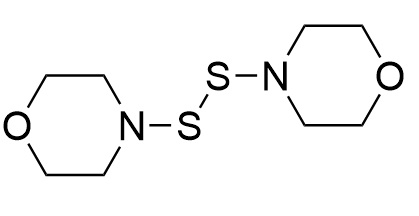
CAS NO: 103-34-4
Specification:
| Item | Specification |
| Appearance | White powder |
| Initial Melting Point [min °C] | 120,0 |
| Ash Content [max. %] | 0,30 |
| Loss on drying [max. %] | 0,30 |
| Residue on sieve [max. %] | 0,50 |
| Oil content | 1,0-2,0 |
| NO. | Item | Unit | Specification | |
| 1 | Appearance | – | White powder | |
| 2 | Initial M.P. (Min) | °C | 120.0 | |
| 3 | Loss on drying (Max) | % | 0.30 | |
| 4 | Ash (Max) | % | 0.30 | |
| 5 | Residue on sieve (Max) | % | 1.00 (63µm) | 0.50 (850µm) |
| 6 | Oil content (*) | % | 0; 1.0–2.0 | — |
(*): Upon customer’s request
What is DTDM?
DTDM (4,4′-Dithiodimorpholine) is a sulfur-containing rubber vulcanizing agent widely used in the rubber industry. It is designed to act as a slow-release sulfur donor, providing excellent control over the vulcanization process.
DTDM improves scorch safety, reduces the risk of premature vulcanization, and enhances heat resistance and aging properties of rubber products, making it especially suitable for high-temperature applications.
Properties:
This product appears as white to light yellow crystalline powder or granules. Its specific gravity is approximately 1.40. It is slightly soluble in common organic solvents and insoluble in water. DTDM has good thermal stability, low odor, and low blooming tendency. It should be handled with care and stored away from heat and strong oxidizing agents.
Application:
It is widely used in natural rubber (NR) and synthetic rubbers such as SBR, BR, NBR, EPDM, and IIR. DTDM is commonly applied in tires, rubber hoses, conveyor belts, seals, gaskets, and heat-resistant rubber products, where controlled vulcanization and improved aging resistance are required.
Packing:
In 25kgs bag.
Storage:
Store in a cool, dry, and well-ventilated place, in tightly sealed packaging, away from heat, moisture, and strong oxidizing agents. The storage life is typically 1 year when kept in its original, unopened packaging.