Accelerator ZDC(EZ)
Product name: ZDC(EZ)
Chemical name: Zinc diethyl dithiocarbamate
Structure:
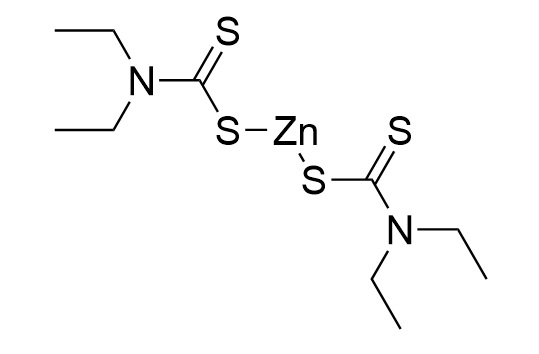
CAS No.: 14324-55-1
Specification:
| Item | Granular | Powder | Oil powder |
| Appearance | White granular | White powder | White powder oily powder |
| Initial melting point [≥ °C] | 174 | 174 | 174 |
| Loss on drying [≤ %] | 0.40 | 0.40 | 0.40 |
| Zinc content [%] | 17.0–19.0 | 17.0–19.0 | 17.0–19.0 |
| Residue on 100 mesh sieve [≤ %] | – | 0.1 | – |
| Granular diameter [mm] | 1.5-3 | – | – |
| Broken strength [N] | 2-5 | – | – |
| Oil content [%] | – | – | 1.0-2.0 |
What is ZDC?
ZDC (Zinc Diethyldithiocarbamate) is a highly effective ultra-accelerator used in both natural and synthetic rubber compounds. It can serve as a primary or secondary accelerator, providing fast curing and excellent processing performance in NR, IR, BR, SBR, NBR, EPDM, and their latexes. ZDC is especially valuable for dipped, spread, and cast rubber products, where rapid vulcanization is required. While it has slightly lower scorch resistance than PZ, it offers consistent curing and contributes as an antioxidant in adhesive systems, enhancing the durability and quality of finished rubber products.
Properties:
ZDC (Zinc Diethyldithiocarbamate) is a tasteless compound with a specific gravity of 1.47–1.50. It is soluble in carbon disulfide, toluene, chloroform, and benzene; slightly soluble in acetone and carbon tetrachloride; and insoluble in water, gasoline, and ethanol.
Applications:
ZDC is a fast-acting primary or secondary ultra-accelerator used in natural rubber (NR), isoprene rubber (IR), butadiene rubber (BR), styrene-butadiene rubber (SBR), nitrile rubber (NBR), EPDM, and their latexes. It is particularly effective in dipped, spread, and cast rubber products, offering rapid curing and strong performance. ZDC has properties similar to PZ (Zinc Dibutyldithiocarbamate) but shows slightly lower scorch resistance and a minor tendency toward premature vulcanization. Additionally, it functions as an antioxidant in adhesive systems, enhancing the durability of rubber-based products.
Packaging:
Available in 25 kg bags.
Storage:
Store in a tightly sealed container in a cool, dry, and well-ventilated area. Under normal conditions, the recommended maximum storage life is 1 year.