Chemical name: 2,6-Di-terbutyl-4-methyl phenol
CAS NO:128-37-0
Chemical Structure:
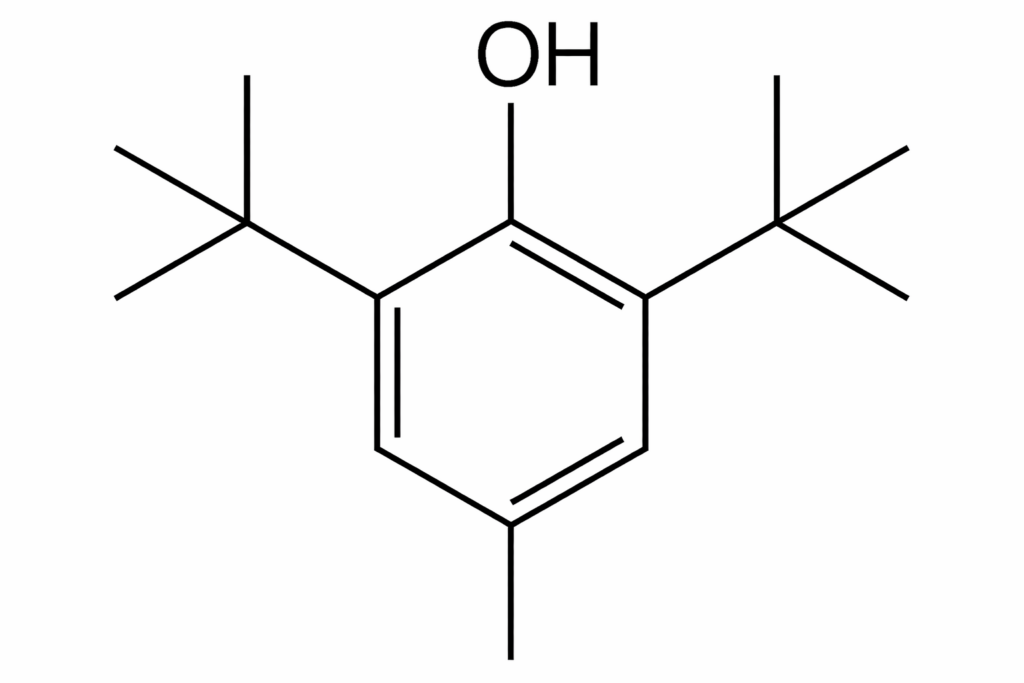
Specification:
| Item | Food grade | Industry grade |
| Appearance | White crystal | White crystal |
| Melting point | 69.0-70.0 °C | 69.0-70.0 °C |
| Moisture | 0.1% Max. | 0.05% Max. |
| Sulphate (accounted as SO4) | 0.002% Max. | 0.01% Max. |
| Free phenols (based on p-cresol) | 0.015% Max. | 0.015% Max. |
| As | 0.0001% Max. | |
| Heavy metal (Pb) | 0.0004% Max. | |
| Ash | 0.01% Max. |
What is BHT?
BHT (Butylated Hydroxytoluene), also known as Antioxidant 264, is a widely used phenolic antioxidant in the rubber, plastics, food, and cosmetic industries. It is designed to protect materials from thermal oxidation, heat aging, and degradation caused by oxygen during processing and service life.
In the rubber industry, BHT helps improve aging resistance, maintain elasticity, and preserve mechanical properties, making it an important additive in rubber formulations.
Properties:
This product appears as white to pale yellow crystalline powder or flakes. Its specific gravity is approximately 1.05. It is soluble in organic solvents such as benzene, chloroform, ethanol, and acetone, but insoluble in water. BHT has low toxicity and good thermal stability. It is combustible, therefore it should be kept away from open flame and high temperatures during storage and transportation.
Application:
It is widely used in rubber products, plastics, adhesives, lubricants, and petroleum products. BHT is also used as an antioxidant in food and feed, as well as in cosmetics and pharmaceuticals, to prevent oxidation and extend shelf life.
Packing:
In 25kgs bag.
Storage:
Store in a cool, dry, and well-ventilated place, in tightly sealed packaging, away from heat, moisture, and strong oxidizing agents. The storage life is typically 1 year when kept in its original, unopened packaging.