Accelerator NOBS(MOR,MBS)
Product name: NOBS(MOR,MBS)
Chemical name: N-Oxydienthylene-2-benzothiazole sulfenamide
Structure:
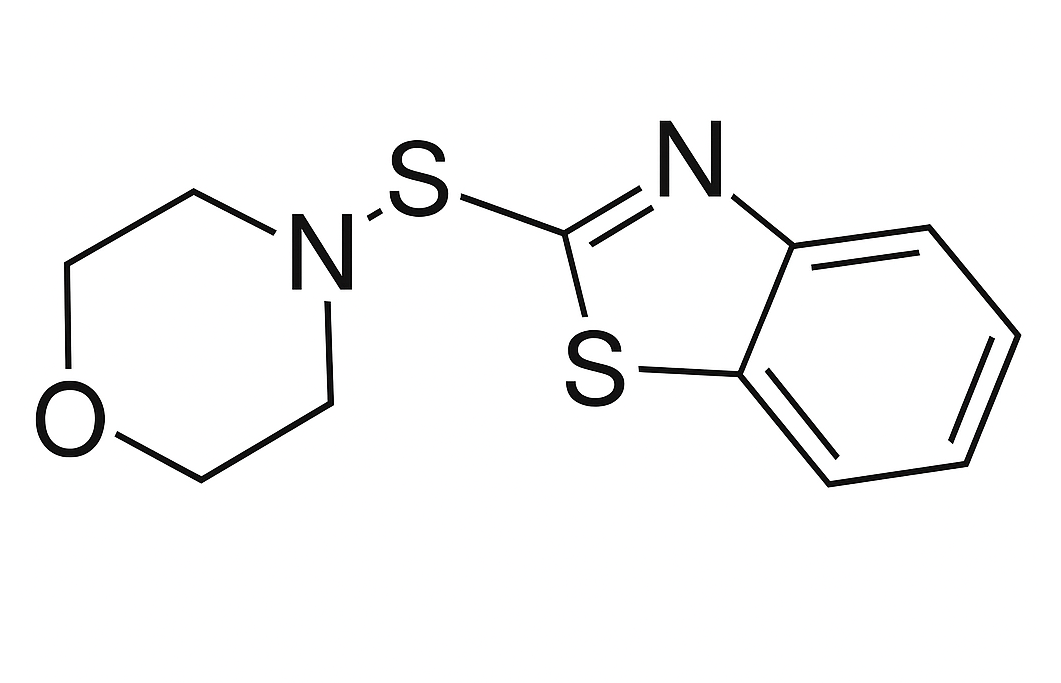
CAS No.: 102-77-2
Specification:
| Item | Granular | Powder | Oil powder |
| Appearance | Light yellow granular | – | – |
| Initial melting point [≥ °C] | 80 | – | – |
| Loss on drying [≤ %] | 0.50 | – | – |
| Ash content [≤ %] | 0.30 | – | – |
| Residue on 150 mesh sieve [≤ %] | – | – | – |
| Granular diameter [mm] | 1.5-3 | – | – |
| Broken strength [N] | 2-5 | – | – |
| Oil content [%] | – | – | – |
What is NOBS?
NOBS (N-Oxydiethylene-2-benzothiazylsulfenamide) is a highly effective delayed-action accelerator used in the rubber industry. It provides controlled vulcanization with excellent scorch safety, offering performance similar to CZ but with reduced risk of premature curing.ts non-blooming property and reliable performance make it ideal for the production of tires, shoes, and belts, although it is not suitable for food-contact applications due to its bitter taste after vulcanization.
Properties:
NOBS (N‑Oxydiethylene‑2‑benzothiazylsulfenamide) appears as a light yellow-brown powder or granules with a characteristic bitter taste. It has a specific gravity of 1.34–1.40. NOBS is soluble in benzene, acetone, and methanol, but insoluble in water.
Applications:
NOBS is an excellent delayed-action accelerator with performance comparable to CZ (N-Cyclohexyl-2-benzothiazylsulfenamide) but with enhanced scorch safety. It is widely used in natural rubber (NR), isoprene rubber (IR), styrene-butadiene rubber (SBR), nitrile rubber (NBR), and EPDM. NOBS can be used alone or in combination with other accelerators such as thiurams, guanidines, and dithiocarbamates to improve curing activity. It is primarily applied in the manufacture of tires, shoes, and belts. The product is non-blooming, but due to its bitter taste after vulcanization, it is not suitable for use in beverage or food-contact applications.
Packaging:
Available in 25 kg bags.
Storage:
Store in a tightly sealed container in a cool, dry, and well-ventilated area. Under normal conditions, the recommended maximum shelf life is 1 year.